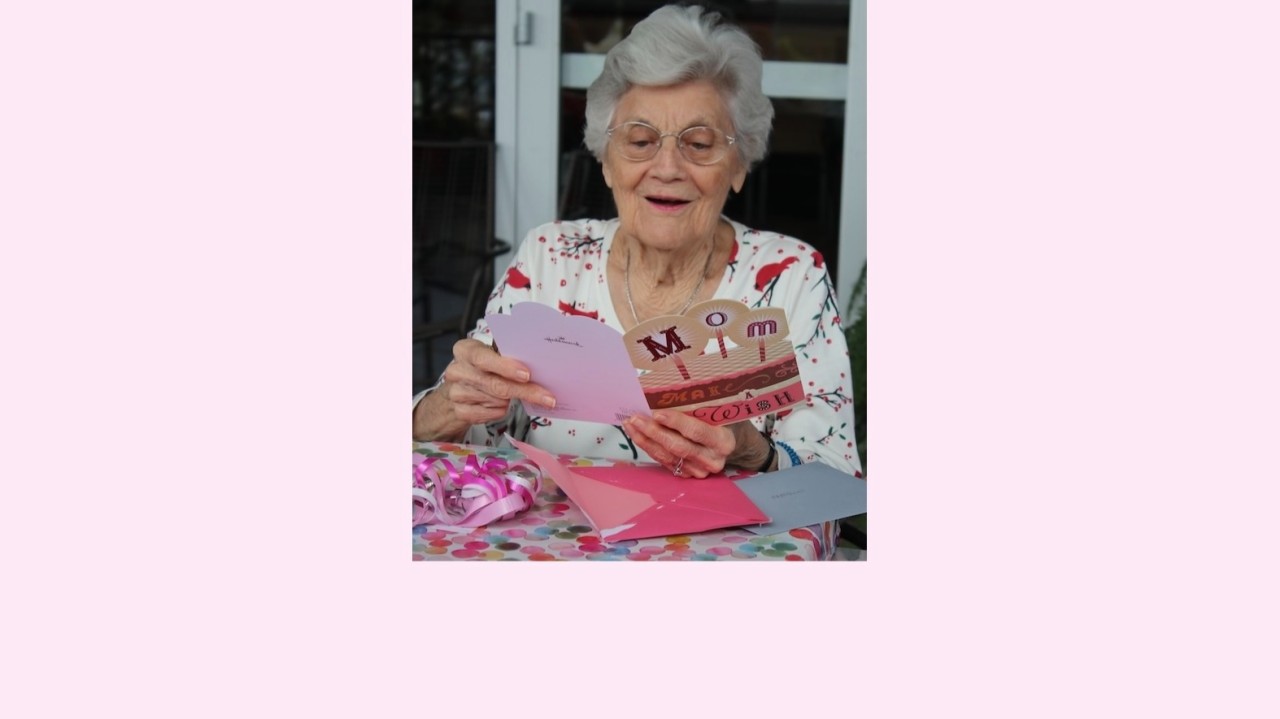
Mom’s six-year journey unfolded in five acts. Stage Directions are the lessons I wish I’d had.
“Do I look beautiful today?”
The question came out of nowhere. Mom was 95 and in her final weeks. Alzheimer’s had slowly taken her independence, her voice, and much of her connection to the present. Yet her face was growing smoother, almost younger. I teased her about secret Botox appointments. A beautician now came regularly, shampooing and setting her hair—something she’d always loved.
But that day, when she looked up and asked, it was unmistakably my mother.
“Yes, indeed,” I told her. “You look beautiful today, Mom.”
Mom had trained as a beautician. She was never vain, but always put together: hair done, lipstick on, clothes matched. Her question cut through six years of Alzheimer’s, connecting the woman in the bed to the mother I remembered.
Getting from one to the other had been a long journey. I often recognized a moment’s significance only after it had become a last.
Act I — When Independent Living Stopped Being Independent
In March 2020, my parents reluctantly agreed to a trial move from their longtime home in a small North Carolina town to a senior community less than two miles from me. They entered at the independent-living level. Four days later, COVID-19 locked the building down. The trial became permanent.
Dad barely qualified for independent living, while Mom appeared fully capable. His physical problems and memory lapses were obvious; she quietly covered for him. They were a package deal, with Dad essentially riding Mom’s coattails. COVID added another layer of camouflage. For nearly four months, I could only drop supplies at the entrance and wave as staff took them inside. When the building reopened to one visitor per week, I reserved Fridays for my parents. Those Fridays became the scaffolding that helped them stay independent—eventually filled with lunches and an increasing number of medical appointments.
Gradually, I began noticing subtle signs in Mom. She blamed several falls on the hardwood floors, so we moved to a carpeted apartment. Despite coordinating appointments on a calendar, they began arriving downstairs an hour or two early. When Dad’s pill boxes seemed scrambled after I filled them, I suspected Mom was starting him on the wrong day. Each incident had a plausible explanation. Together, they told a story I didn’t yet know how to read.
The turning point came when Mom’s baby brother, born during her senior year of high school, suddenly fell ill and died. She repeatedly asked how he was doing, unable to retain either his death or the events surrounding it. For the first time, what was happening to Mom became impossible for me to explain away. Her primary care doctor ordered tests and referred us to a neurologist. Balance problems led to a rollator—she could still fly with it—but by early 2022, more visible lapses appeared. She might suddenly forget how to operate the washer or what to serve for lunch.
The final straw came while my husband, daughter, and I were in NYC. Mom called to say she and Dad had arranged transportation home. She sounded convincing enough that I begged her to wait until we returned. Dad likely belonged in assisted living from day one. But it was Mom’s cognitive decline—not Dad’s physical limitations—that finally made independent living impossible for both.
In May 2022, they moved.
Stage Directions
Know what independent really means. Independent living is primarily housing and community, not caregiving. The model assumes residents can largely manage their own lives.
Look for the pattern, not the individual problem. A fall, missed appointment, or medication mix-up can each have an innocent explanation. Cognitive decline may emerge only when you ask what the incidents are telling you collectively.
Assess capabilities—not just diagnoses—and assess a couple twice. Physical limitations are easier to see; cognitive decline can hide behind routines or a more impaired spouse. Understand what each parent can do independently and then how they function together.
Act II — When Assisted Living Needed More Assistance
We gave my parents a choice among several assisted-living communities, and they chose the one in South Carolina with a small-town feel and a room overlooking a large backyard. On their first weekend, Mom began calling me at two or three in the morning. Her story was almost always the same: someone had dropped her and Dad off at a motel near the beach. They had no car, no money for food, and no way home. She cried and sometimes screamed at me. I wondered if I had made a terrible mistake.
I expected assisted living to solve what independent living couldn’t: manage medications, handle meals and laundry, and respond when my parents needed help. I didn’t realize how much the model still relied on residents’ abilities to recognize a need, press a call button, and explain what was wrong. Dad could no longer do so reliably. Mom couldn’t either.
I hired Visiting Angels to help them learn the routines, expecting a few weeks of support. Instead, a few mornings grew into daily support, eventually extending into the afternoon. One Angel who arrived during their first week became Mom’s primary caregiver for the next four years. My husband and I used a camera to check on meals and medications and called the facility if either was missed. Assisted living provided the setting; we increasingly made the pieces work together.
Mom eventually settled into a strange Jekyll-and-Hyde pattern. One day she seemed almost entirely herself; the next, she was packing to leave their motel room. This pattern persisted for more than a year. As her cognition declined, Dad’s physical needs also reached a point where assisted living could no longer support him. Hospice in their apartment became the only practical way to keep them together.
He received hospice care for only 13 days. Late one Thursday night in October 2023, I stayed with him in their apartment when he quietly passed. We had arranged for Mom to sleep in memory care that night so she could be safely supervised while I focused on Dad. The next morning, I had to tell her he was gone.
“Your dad wasn’t even sick,” she kept saying. The person who had made every unfamiliar place feel like home was gone.
Stage Directions
Understand what assistance entails. Assisted living supports daily activities, but residents still need to recognize their needs and request help. Understand what the facility proactively provides—and what you may need to supplement.
Learn about dementia from people who live with it. Medical experts make the diagnosis, but experienced caregivers and families better understand the accompanying behavioral changes.
Act III — When Grief Accelerated the Decline
My husband and I drove Mom three hours to their home church for Dad’s funeral. She looked like herself—dressed carefully, hair done—but moved as if sleepwalking. Before the service, she seemed comforted by how peaceful Dad looked. Within days, she had forgotten the funeral and even his passing. Each time she asked where he was, she heard the news as if for the first time.
Mom’s stay in memory care was meant to be temporary—until her grief and confusion made it clear she needed closer supervision. We moved her belongings into a small studio, but the locked unit and unfamiliar residents frightened rather than comforted her. A month later, she returned to assisted living, one floor above the apartment she had shared with Dad.
But a different woman came back. Less than a week before Dad died, Mom still managed her clothes and toiletries. Now she might wear the same outfit for days. Her longtime Angel began laying out her clothes the night before, then helped her dress, and eventually simplified her wardrobe to comfortable tracksuits.
Managing Mom’s medications became a balancing act: enough to control her depression and anger without leaving her groggy and more prone to falls. I was the go-between for her neurologist and the caregivers, seeing the effects firsthand, until the facility’s medical director told me to hand that role to hospice. It felt like signing a six-month death sentence. Instead, hospice became the medical integrator we needed—and a lifeline for the next two years.
We also had to adjust how we responded to her changing reality. At first, when she asked where Dad was, we told her the truth: he had died and gone to Heaven. Our explanations only made her relive his loss. Eventually, we learned to appreciate therapeutic fibbing. When Mom asked where Dad was, I said he was working late or at a church deacons’ meeting, then quickly changed the subject. We stopped pulling her into our reality and learned to meet her in hers.
Routine gradually gave her something solid to hold onto. Her Angel arrived each morning, helped her get ready, and took her to meals and activities. I kept our Friday lunch tradition, and she enjoyed getting out with me. On Friday, September 13, 2024, we went to Papa Doc’s for a lake-view lunch. Mom insisted on walking the long, bridge-like entrance with her rollator and happily ordered a seafood platter. I had no idea it would be our last outing.
The following week, my husband watched over Mom while I was at an out-of-town meeting. He saw her fall four times in just over a day—panicked and added second- and third-shift Angels. I returned to find that the woman who had walked that long entrance the week before was now in a wheelchair. She would not leave the assisted living facility again until her final move.
Stage Directions
Understand the gray zones between levels of care. Assisted living and memory care aren’t separated by a bright line; their capabilities and resident populations often overlap and vary by facility. Understand where that line falls, then match the environment to the person—not simply the diagnosis to the label.
Integrate medical care as needs increase. More specialists don’t necessarily lead to better care. Someone needs to see the whole person, reconcile competing priorities, and translate medical decisions into everyday care. Hospice can play that integrating role.
Stop insisting on your reality when reason no longer works. Correcting someone with dementia can cause distress without fostering understanding. Entering their reality may feel uncomfortable for you, but it may be exactly what they need to hear.
Act IV — When Her World Became Smaller
The wheelchair narrowed Mom’s world but didn’t immediately confine her. She still went downstairs for meals, sat outside, and took a few assisted steps with her rollator. Most days, her life revolved around her wheelchair and lift recliner. Her brain no longer seemed able to tell her body what to do, and she needed two people to move her safely.
Hospice noted most signs of continued decline, but she was not yet transitioning. Most notably, Mom still ate. Breakfast remained her favorite, though at other meals she sometimes ate with her fingers or played with her food. Her reality was also moving backward in time. She still asked about Dad and sometimes spoke to him, but increasingly inhabited a world of her parents, siblings, and childhood neighbors.
Yet this period brought surprising moments of joy. I’d enter her room saying, “Knock, knock,” and she’d beam. Conversation became one-sided, so I’d share photos or read her hometown newspaper aloud, marveling at how familiar names could unlock vivid memories from decades past. Calls with her sister sometimes did the same.
Music reached her even more deeply. For her 94th birthday, I hired a local pianist to play at dinner. When he played “Amazing Grace,” Mom and many others sang every word. That evening, dementia seemed far away.
For over a year, Mom had remained stable at her new, lower level. The daily handoff from her Angel to facility caregivers, hospice’s coordinated care, and my evening visits became routine. We even had a template for family travel with detailed logistics, contact information, and an in-town emergency backup for her full care team. It had never needed to be tested.
Then, on New Year’s Day 2026, the routine broke. Her Angel sent photos of Mom smiling in a party hat at lunch. That evening, her caregivers called to say she was struggling to breathe and needed oxygen and low-dose morphine. We were away with our daughter for the holidays and tried unsuccessfully to move up our return. When we landed, I went directly to her. She was asleep in her recliner and barely registered my visit. The next day, hospice changed her care plan to eliminate transfers to the recliner. Mom was bedridden.
Stage Directions
Redefine independence as abilities change. A wheelchair doesn’t have to mean room- bound. When one ability fades, look for the safe lanes of movement, choice, and agency that remain.
Let the definition of a good day evolve. Music, familiar voices, old memories, and small moments can still bring joy. Decline doesn’t erase joy; it shifts where you find it.
Build the safety net before you need it. A stable plateau can change without warning. Make sure everyone knows the care plan, how to reach you, and who can step in locally when you can’t.
Act V — The Long Goodbye Ends
From January on, Mom’s eating, bathing, dressing, toileting, and medical care took place in bed. Her days settled into a rhythm of sleeping and waking to The Andy Griffith Show or to scenic screensavers with soft piano music. Her appetite faded, but she still seemed to enjoy the small dinners I fed her.
Her care system unexpectedly began to fray. The facility changed management, and familiar caregiving staff left. In April, her longtime Angel fell and was badly injured. Her weekend Angels backfilled the weekdays, and I continually oriented new people to fill the remaining gaps.
Then came the shock: in May, the facility director informed me that Mom would be “involuntarily discharged” because she “wasn’t dying fast enough.” We’d always been reassured that hospice residents could pass in place, but her needs had outgrown the facility’s licensing. We had 30 days to find another home.
That terrified me. The long-term-care facilities I’d seen looked sterile and institutional. We found a six-resident home specializing in advanced care across the state line—returning home to North Carolina. Mom turned 95 two days before the move, so I wrapped photos of her new home as a birthday present. My husband, daughter, and familiar Angels and caregivers celebrated with us. Mom stayed alert, recognized everyone, and happily ate a favorite meal of pancakes, eggs, and cupcakes.
That Friday, we moved her. The new home had equipment to safely transfer Mom from the bed to a reclining wheelchair. She could sit at the dinner table, watch TV with other residents, and look outside from the porch. The home provided all her care. After years of orchestrating the pieces, I could visit as her daughter rather than as her care manager.
We had about two good weeks.
On June 23, her hospice nurse called: “The light has gone out.” By the next day, she was convinced Mom was transitioning. The clearest sign was food: after years of decline but continued eating, Mom stopped wanting food or drink. Hospice said to let her body lead.
Those closest to Mom gathered around her: her longtime Angel, familiar caregivers, and local family. Her sister called daily, and I held the phone so Mom could hear her voice. My daughter flew in, and Mom still recognized her. She sang “I Wanna Go Back” from The Notebook, the Musical —a song about home and memory. She would sing it again at Mom’s funeral.
A young caregiver at the new home became devoted to Mom—her first actively dying patient. She struggled not to coax food or water. Then a senior hospice nurse spent more than an hour with us, explaining how the body shuts down and why forcing food can make things harder. Understanding what her body was doing made her transition less frightening.
On July 2, I spent the afternoon at Mom’s side. Her breathing slowed, with long pauses. I’d just returned from the bathroom when my husband called. As I described what I was seeing, Mom took another breath and paused. This time, she didn’t resume.
It was 4:52 p.m.
My husband and daughter joined me. Hospice and the caregivers surrounded us as we waited for the funeral directors to drive three hours from Mom’s hometown. I stayed until they arrived, then left before they moved her body. I wanted my last image of Mom to be peaceful, asleep in bed.
Stage Directions
Don’t assume that similarly labeled care settings operate the same way. Regulations, licensing, staffing models, and owners’ philosophies can create very different capabilities. Look beyond the label to understand what each setting can provide.
Learn what dying looks like before you need to. Understanding how the body naturally shuts down—including changes in eating and drinking—can make an unfamiliar process less frightening. Knowledge doesn’t eliminate grief, but it can replace fear with awe.
What the Whole Journey Taught Me
As Dad was dying, I promised him I’d take care of Mom. I kept that promise by caring for her wherever home happened to be. Three lessons became clear only over the full course of the journey:
Expect the care environment to evolve. I learned there was no single right place for Mom—the right answer changed as she did. Understanding the options, recognizing her changing abilities, and advocating for what fit now became part of the job.
Protect the family relationship whenever you can. Not every family can afford caregivers, but whatever your resources, find ways to be family—not just a caregiver. I didn’t appreciate that distinction until Mom’s final home took over her care and I could walk in simply as her daughter.
Live the moments; don’t chase the lasts. Most lasts don’t announce themselves. I didn’t know our seafood lunch would be Mom’s last outing, or which “goodnight” would be the last. I visited every day I was in town. The point isn’t to spot the last—it’s to live ordinary moments so you won’t wish you’d treated them differently if one turns out to be the last.
Dad had gone ahead. Now it was time to take her all the way home.